Patriotic Kitchen

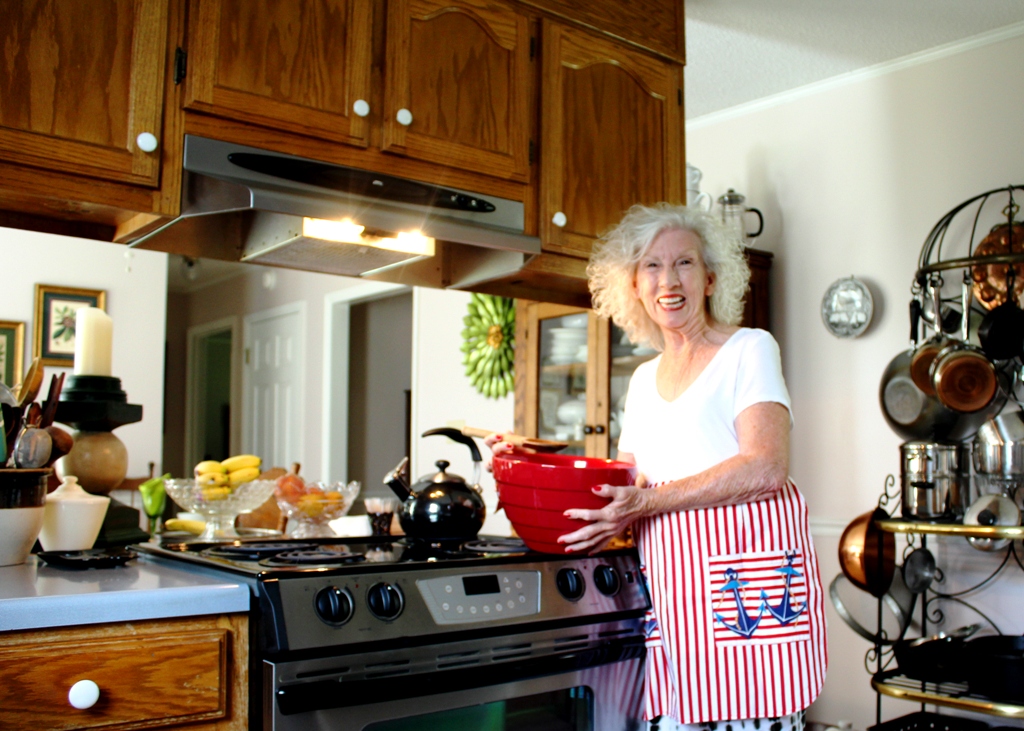
Sage Hill’s Patriotic Kitchen is more than a place to cook and eat…although that is a priority…most days…..It’s also a place where honest, hard working people, dedicated to love of God, family, and country, come together to feast…not only with food, but with love and respect for all those whom have gone before us…paved the way…paid the price….left a legacy worthy of carrying on.
My patriotic kitchen has birthed good music, blues, country, and gospel…
Football is sometimes king and the southeastern conference is the kingdom….
In my Patriotic kitchen age matters…yes ma’am…no ma’am…please and thank you.
You can wear shoes or not, no one cares…but you will say grace and salute the flag…for you see…my Patriotic kitchen is a state of “Amazing” grace.
Kitchen

Season of the Pumpkin

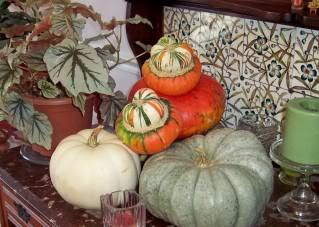
Around our house October and November mean lots of pumpkins, big fat orange ones, and dainty, and not so dainty, white ones, fat, skinny, perfect and totally warped ones. I never ever have enough pumpkins to satisfy my never-ending use for them. Of course the pumpkin isn’t the only autumn fruit/vegetable that is worthy of attention in the colorful scheme of this most loved part of the year.
Gourds, corn stalks, and the different array of apples, from green to yellow to red and a combination of all the previous mentioned colors, it really is the most colorful season.

We enjoy using the colorful selection as an inviting grouping on the front porch, a lovely selection of pumpkins on the farm table in the dining room is very fitting.
A few scattered around the gardens provide a little touch of color to a somewhat fading look by this time of year.

And…of course we must not forget the Jack-O-Lantern.

What would October be without that special face sitting by the door greeting everyone who passes by or comes to call.

One of my very favorite uses for the pumpkin is in the kitchen of course.

For the family meal at Thanksgiving I use a medium size “Sugar Pumpkin”…(best for cooking)as a serving bowl for our favorite stew.

Sugar Pumpkins

The options are many, just use your imagination for the stew.

Cut the top from a medium size Sugar Pumpkin, scoop out at least half of the pulp/without leaving the shell too thin. Set aside to use in the stew.

In a large deep pan place the pumpkin in boiling water, about 1/3 of the way up on the pumpkin.
Place in a very hot oven and cook until all the water is gone or until the pumpkin is just starting to get soft.(don’t overcook)

Remove from oven, let sit for a few minutes to cool slightly.

Sprinkle the inside with salt and pepper or your favorite spices.

Saute’ the firm parts of the pumpkin pulp, season according to your other ingredients. Stir all together and add to the pumpkin shell. Put it back in the oven and cook about 20 minutes, just enough to blend the flavors.

Makes a lovely centerpiece for the table and delicious too!

Enjoy this season, however you celebrate …it is ever so special.

Christmas As Seen Through The Eyes Of Dickens~

The Christmas Story…according to the Christmas Bible story, Christ came down to earth from heaven to be born at Christmas, because of his love for all humanity.

Christmas Through the Eyes of Dickens~(1812-1870)
( a cry for social justice )

Christmas in Scrooge’s day…in 1843 Christmas was much less commercial. Many people went to church, and many followed the ancient tradition of making merry. however, nothing was allowed for or geared to the working class or poor classes of people
We all know the heart-tugging story of  “A Christmas Carol” by- Charles Dickens…what many may not know are some of the historical facts that inspired this classic.

The English Christmas was at a low ebb when Dickens was a youngster.
his desire was to make it understood and to change how the working poor lived from day to day. Dickens loved his city and spent his life wandering the streets, by the time he was 15 he know it well…yet never stopped exploring and writing about its restless energy.

Much of today’s London was built in the 19th Century,
it was full of dark alleys and lanes, the streets were crowded, noisy, and very dirty.
Almost anything was bought and sold, the atmosphere was more akin to a modern third-world city than modern London. Many of the vendors were children-there were no child labor laws such as we have today. Many worked as young as 5-sweeping the streets.

The growth of the city exploded in the 1800’s and became know as “the Fever-Patch.” It was the first big industrial city in the world, and it was dirty, extremely polluted and unhealthy. disease spread quickly…there were four cholera epidemics in Dickens’s lifetime. plus regular outbreaks of typhoid, scarlet fever,, and other ills. Two hundred open sewers ran into the Thames River…and more than half of the London population took their water from it for cooking, laundry, bathing and drinking.

“A Christmas Carol” was written in 1843, as was the first printed Christmas cards. However in 1843 many very old traditions were still being celebrated. Some dated from ancient pagan midwinter festivals-which were celebrated long before the first Christmas. The latter part of the 1840’s began to see signs of new customs and ways that brought London out of the disgusting conditions it had become famous for.

The year after ” A Christmas Carol” was published , nine London theaters staged versions of this book…it has been a favorite of stage and screen ever since. The classic being the 1951 version.

After the success of ” A Christmas Carol” Dickens wrote a Christmas story each year for the next several years, including The Chimes,(1844) and The cricket On The Hearth (1845)-none were as popular as A Christmas Carol. It added a new word to the English language (“a Scrooge” is a miser…very few stories have done that.

Today’s Christmas is commercial in a way Dickens could not have dreamed of…but in part and thanks to him, we still feel that Christmas should be a time for family warmth, wholesome fun, kindness to others and especially children…his vision lives on~ RIP Charles Dickens.

Merry Christmas~

The Sage Hill Farms Family~ 

Christmas

salmon patties
My first memory of these delicious little cakes go back to the late 1940’s… the WWII years when food was carefully chosen to get the most for the needs at hand….. shopping was not the event that we know today….many things were scarce are totally unavailable….. most people grew/raised their own food…..most men were in the war , away from home, farm, family….. A good memory from a not so good time.
My mother made a sauce of catsup, mustard, and pickle relish…when we had all ingredients…one would often be the choice…. a hot biscuit, sliced onion and the salmon patty was my favorite .

  • 1 (14.75 ounce) can salmon, undrained and flaked
  • 1 slice of bread, shredded
  • 3 Tbsp chopped green onion, including the green parts
  • 1 medium garlic clove, minced
  • 1 Tbsp fresh chopped dill weed, or 1 teaspoon dried
  • 1 Tbsp flour
  • 1 egg
  • 1/2 teaspoon sweet paprika
  • 2 teaspoons lemon juice
  • 1/2 teaspoon Sea salt
  • Several turns of freshly ground black pepper
  • 3 Tbsp grape-seed oilBlend all ingredients with a wooden spoon until easily to form a patty cake by hand.
    Heat a griddle pan slightly oiled and fry on med heat until brown and crispy or less cooking if crisp isn’t desired.

These are a childhood favorite…they can be served on a bed of greens with a spicy Cajun sauce …. Remoulade.. recipe below

On a bun as a burger with your choice of toppings…thick sliced onion and green tomato are yummy! or red tomato!

Served alongside your egg and asparagus brunch dining…

Or…one of my favorite ways is snacking while on the move….

A hot cup of herbal tea (or coffee) a couple of patty cakes and a walk through the gardens mid morning or early evening…..Oh yeah!!

Remoulade Sauce…

  • 1 large egg yolk
  • 1/4 cup Creole Mustard
  • 2 1/2 tablespoons red wine vinegar
  • 1 tablespoon prepared horseradish
  • 1 teaspoon kosher salt
  • 1 teaspoon paprika
  • 1/2 teaspoon cayenne pepper
  • 1/4 teaspoon freshly ground black pepper
  • 1 clove garlic, minced
  • 3/4 cup vegetable oil ( I cut back to 1/2 cup and use an alternative oil…grapeseed
  • 1/4 cup olive oil
  • 1/2 cup finely minced celery
  • 1/4 cup plus 2 tablespoons minced green onion
  • 1/4 cup mayonnaise
  • 1 tablespoon ketchup
  • 1/4 teaspoon Worcestershire sauce

DIRECTIONS

  • In a nonreactive mixing bowl, whisk together the egg yolk, mustard, vinegar, horseradish, 3/4 teaspoon of the salt, the paprika, cayenne, and black pepper. On a cutting board, mash the garlic and the remaining 1/4 of salt together, using the side of a chef’s knife to form a paste. Add the garlic paste to the bowl and whisk to combine.
  • Combine the oils in a measuring cup with a pour spout, and while whisking continuously, drizzle the oil blend very slowly into the mustard mixture until a smooth, thick emulsion is formed. Whisk in the celery, green onion, mayonnaise, ketchup, and Worcestershire sauce. Chill thoroughly before using; the remoulade will keep for up to 4 days in the refrigerator.

Posted on  by 

PicklesPickles      
This Last week has been a wonderful Independence Day Retreat for me…
Lot’s of family time, friends, and “me” time!
I feel blessed and refreshed…
Today was a welcome back work schedule…..
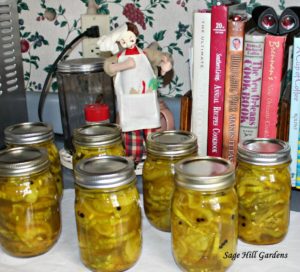
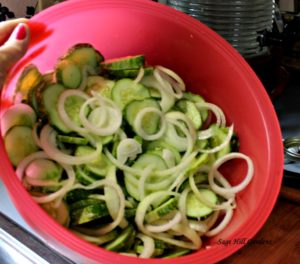
This Bread&Butter pickle recipe goes back generations in my mothers family….probably yours also.
God Bless America… Another birthday to be grateful for!Thank you Lord for family and B&B Pickles!pickles

Patriotic

Herbs, Home and History~

Nothing more patriotic than home embraced….

Those who know me well know I’m an avid history buff…the more ancient the times, the more intense the interest.

I found this to be a very calming bit to know.

In Victorian times the seeds of Fennel came to symbolize the virtue of strength.
(a patriotic truth.)

At one time , fennel seeds were combined with those of Dill and Caraway in little sacks or purses, to be chewed at prayer meetings to quell hunger pangs; they were
known as “meeting seeds.”

Fennel is a self sowing herb valued for it’s distinctive aroma.
The leaves have an aniseed aroma.

I make this wonderful cleanser for my skin a couple of times a week during the winter.

1 tablespoon fennel seed
8 ounces of boiling water
1 teaspoon local honey
2 tablespoons buttermilk

Lightly crush the fennel seeds,
place in the boiling water and allow to infuse for 30 minutes.

Strain the cool liquid into a small bowl, add honey and buttermilk.
Put into a clean bottle and keep in the frig.

Used once or twice a day this will last about a week.

Rub over face and neck or the whole body…leave on for a few minutes and gently rinse away with a soft cloth and warm water.

Leaves the skin silky, clean, and delicious smelling.
(our body is a temple, on loan…treat it with love and respect.)

This makes a lovely wash for children and small babies.
(parents, treat your children like precious jewels…for they surely are)

Little girls adore it and it’s just bold enough that little boys don’t think it’s to girlie.

Enjoy-pamper yourself and your children~

Eat together, sit by the fire, read good books (including the Bible)
Sing, tell stories, laugh and fly the flag high and proud.

A great new year is waiting in the wings….make it a full fledged Patriotic one!!

Trees~A Passion.

I know you’ve heard the term “tree hugger” I could easily, and actually thought of by some to be one.

Trees are so precious, so very much a must in the makeup of a balanced eco-system.
Trees serve as buffers between earth and elements.

Each year I look forward to the type of trees we can add to Sage Hill’s collection.
Some are deep rooted and close to one hundred years old, some are half that age and some are of the younger generation…..some, actually most are weather-beaten, bent, and even broken with mended trunks and branches that refused to die and be no more.

So, come walk with me and meet the Sentinels of the homestead called Sage Hill. *These have been taken by Mother Nature to grace the glorious grounds of Tree heaven!

So far we have the Southern Magnolia, *Norway Spruce, Tulip Magnolia, Golden Maple, *Bradford Pear, *Plum, Japanese Maple, White Pine, Bodock, Spring Apple, Apricot, Pear, Peach, Crape Myrtle, Holly, and Cedars.
~
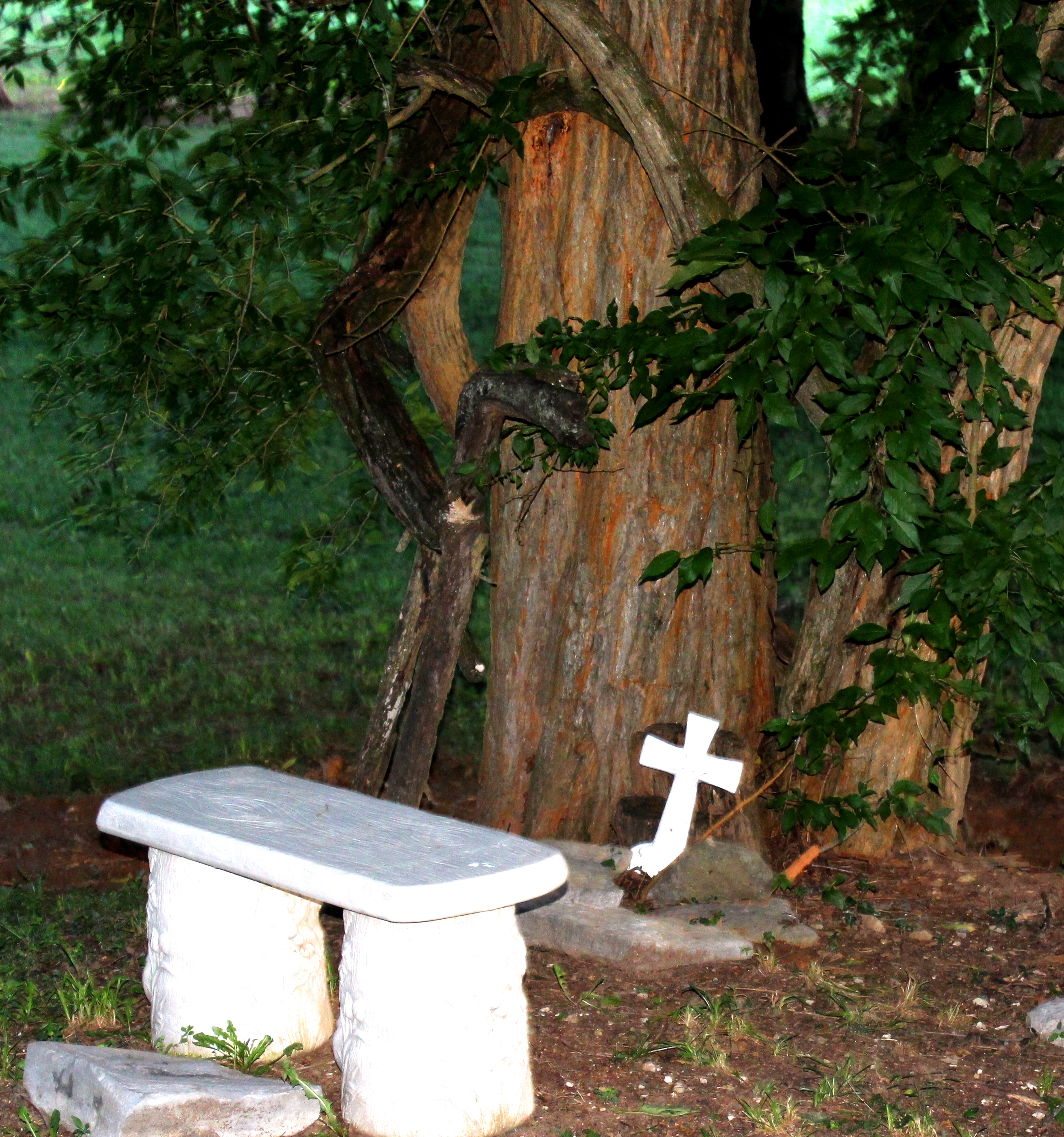
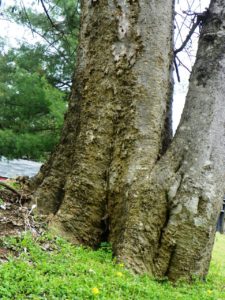
1…The Black  Thorn or Black Locust tree is at least 100 years old, as you can see many years ago it split and managed to survive. The broken section on the ground is another split that took root and survived…..
Agent from the TN Forestry Dept. identified it as a Black Thorn or Black Locust…..the thorns are mighty and will hurt you if care isn’t taken!!
trees
~~

2..The Eastern Red Cedar…was adopted by Legislation as the official Evergreen tree of Tennessee.(2012)

Cedar trees are part of a unique habitat found in Tennessee. The eastern red cedars live on the periphery of cedar glades where soil is very shallow and the limestone bedrock is found near or breaking through the surface.

The tree is sacred to the Cherokee people providing sanctuary for the spirits of their ancestors. Known as the “Tree of Life” the eastern red cedar is often burned in purification rituals. One story associated with the tree is The Legend of the Cedar Tree. It teaches us to accept our blessings and bestow them with gratitude.

The eastern red cedar was one of the earliest landscape plantings used by settlers to the area and can be found on the grounds of Andrew Jackson’s Hermitage in Nashville.

The trees also supported one of the earliest Tennessee forest industries, cedar pencils! ( an old pencil factory not too far from Sage Hill.)

The state capitol in Nashville was built on Cedar Knob and the original name of the street at the foot of Cedar Knob at that time was named Cedar Street (now Charlotte Avenue).

Image may contain: tree, plant, sky, outdoor and nature  
~~3..

The beautiful and ever giving American Holly…about 30 years old…parts of it has been cut away to keep it off the house….( a good point to remember) and should be stressed by landscapers….(Don’t plant trees to close to foundations.)

he American holly is extremely variable, both in the wild and in culture. More than 1,000 varieties have been named. It is generally a slow-growing tree, reaching up to 50 feet in height . Densely pyramidal in youth, it becomes more open with age. The leaves are typical of our image of a Christmas holly — thick and dark green, with spiny edges.

This tree is a female…producing green berries in the spring, which turns orange in the fall and red in the winter….the birds set up housekeeping and has a steady diet of yummy fruit all year!

Image may contain: plant, tree, outdoor and nature 
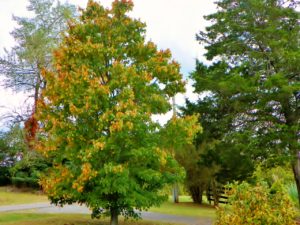
~~4…Maple trees are plentiful in Tennessee also..Sage Hill has a beautiful Sugar Maple and a Large Leaf Maple…Sugar being in the front yard by the driveway and the Big leaf is in the Bog!

Sugar Maple

tree
5..Big Leaf

trees
~~

6..White Pines…a favorite

An herb tree…pine oil is used extensively in homeopathy medicine.

pines
~~

7..Hackberry….

Hackberry trees are among the best food and shelter plants for wildlife. Fruits are very important food source for both migrating and overwintering birds as well as for mammals. Host to many butterfly species including Hackberry, Question Mark and Mourning Cloak butterflies. Also larval host for some moths.

tree
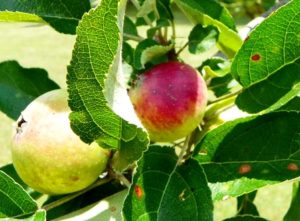
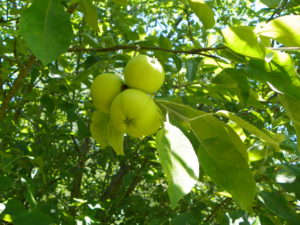
8..June Apple….Old/heirloom variety….looks like a small Granny Smith and very tart…the best for dried or making jelly, pies, etc., not a good snack apple.

tree
~~

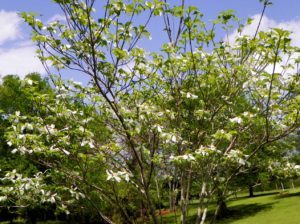
9.. Dogwood’s…Not large and only about 14 years old…beautiful in the mix

trees
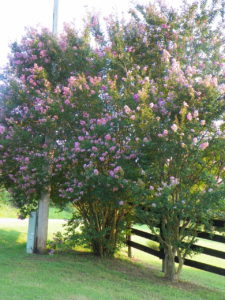
10..Crape Myrtles…some people grow these as trimmed shrub size…these are smaller tree forms about 25 to 30 years old
trees

11.. Cortland apples, Peach, Pear, Plum and Fig
trees
12..Granny Smith…
Granny Smith
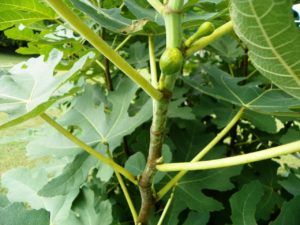
13..Fig
fig
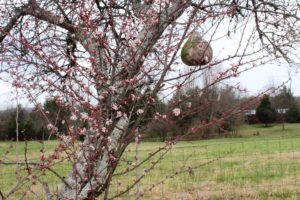
14..Plum

Plum
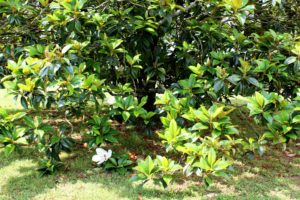
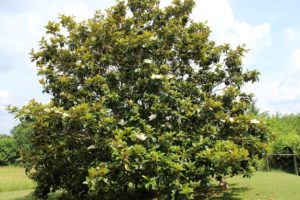
15..The Stately Southern Magnolia

tree
tree
I hope you’ve enjoyed my tour of Sage Hill trees….

Please, if you have a space, plant a tree…if you don’t have space, donate a tree to someone or some place who does…..they are one of our most valuable resources for clean air, food and shelter for wildlife and us human caretakers.

Blessings…

~~

Trees

Joyce Kilmer1886 – 1918

I think that I shall never see   
A poem lovely as a tree.   
   
A tree whose hungry mouth is prest   
Against the sweet earth’s flowing breast;   
   
A tree that looks at God all day,
And lifts her leafy arms to pray;   
   
A tree that may in summer wear   
A nest of robins in her hair;   
   
Upon whose bosom snow has lain;   
Who intimately lives with rain. 
   
Poems are made by fools like me,   
But only God can make a tree.


direction

The beginning of the new year and the time to make New Year resolutions.
If you do-I don’t. As Master Koda say’s- “Do. Or do not. There is no try.”

January was established as the first  month of the year by the Roman Calendar. It was named after the god Janus (Latin word for door). Janus has two faces which allowed him to look both backwards into the old year and forwards into the new one at the same time. He was the ‘spirit of the opening’.

In the very earliest Roman calendars there were no months of January or February at all. The ancient Roman calendar had only ten months and the new year started the year on 1 March. To the Romans, ten was a very important number. Even when January (or Januarius as the Romans called it) was added, the New Year continued to start in March. It remained so in England and her colonies until about 200 years ago.

The Anglo-Saxons called the first month Wolf monath because wolves came into the villages in winter in search of food.

ST. Hilary’s (one L) Feast Day has gained the reputation of being the coldest day of the year due to past cold events starting on or around this date.
One of the most severe winters in history began around 13 January in 1205, when the Thames in London froze over and ale and wine turned to solid ice and were sold by weight.
~
History is the key to the future….we each can learn from visiting ancient to last year’s timelines.

My wish for the masses and the younger generations…Embrace and learn constantly from the past….”When you do not know where you’ve been, you cannot know where you’re going.”

Dickens

The Christmas Story…according to the Christmas Bible story, Christ came down to earth from heaven to be born at Christmas, because of his love for all humanity. 

Christmas Through the Eyes of Dickens~(1812-1870)
( a cry for social justice )

Christmas in Scrooge’s day…in 1843 Christmas was much less commercial. Many people went to church, and many followed the ancient tradition of making merry. however, nothing was allowed for or geared to the working class or poor classes of people
We all know the heart-tugging story of  “A Christmas Carol” by- Charles Dickens…what many may not know are some of the historical facts that inspired this classic.

The English Christmas was at a low ebb when Dickens was a youngster.
his desire was to make it understood and to change how the working poor lived from day to day. Dickens loved his city and spent his life wandering the streets, by the time he was 15 he know it well…yet never stopped exploring and writing about its restless energy.

Much of today’s London was built in the 19th Century,
it was full of dark alleys and lanes, the streets were crowded, noisy, and very dirty.
Almost anything was bought and sold, the atmosphere was more akin to a modern third-world city than modern London. Many of the vendors were children-there were no child labor laws such as we have today. Many worked as young as 5-sweeping the streets.

The growth of the city exploded in the 1800’s and became know as “the Fever-Patch.” It was the first big industrial city in the world, and it was dirty, extremely polluted and unhealthy. disease spread quickly…there were four cholera epidemics in Dickens’s lifetime. plus regular outbreaks of typhoid, scarlet fever,, and other ills. Two hundred open sewers ran into the Thames River…and more than half of the London population took their water from it for cooking, laundry, bathing and drinking.

“A Christmas Carol” was written in 1843, as was the first printed Christmas cards. However in 1843 many very old traditions were still being celebrated. Some dated from ancient pagan midwinter festivals-which were celebrated long before the first Christmas. The latter part of the 1840’s began to see signs of new customs and ways that brought London out of the disgusting conditions it had become famous for.

The year after ” A Christmas Carol” was published , nine London theaters staged versions of this book…it has been a favorite of stage and screen ever since. The classic being the 1951 version.

After the success of ” A Christmas Carol” Dickens wrote a Christmas story each year for the next several years, including The Chimes,(1844) and The cricket On The Hearth (1845)-none were as popular as A Christmas Carol. It added a new word to the English language (“a Scrooge” is a miser…very few stories have done that.

Today’s Christmas is commercial in a way Dickens could not have dreamed of…but in part and thanks to him, we still feel that Christmas should be a time for family warmth, wholesome fun, kindness to others and especially children…his vision lives on~ RIP Charles Dickens.

Tis The Season~


bog

When I was growing up on a farm, there was a place called the Lower 40…40 acres surrounded by tall trees, climbing vines , water holes and a creepy kind of atmosphere…(where my papa grew corn…tall, beautiful, so green it was almost black-corn.) to a very imaginative young mind…that would be mine…it was a most inviting place…..because of snakes and spiders and other harmful beast …it was off limits….to some!!
Well, as I am here and totally intact…I survived!
Wonders never cease or I never stop searching for/finding mysterious and interesting places to wander.

Come into my Bog said the voice to the ear….it’s dark, cool, green, damp, quite and a perfect place to escape reality…or…perhaps come face to face with reality….. You decide….

**In the real world a bog is…. with their primeval feel, they may be defined as areas in which woodland and bog (or mire) co-exist in a relatively stable relationship. They highlight the way in which Nature often blends the boundaries between one habitat and another.